Your cart is currently empty.
Cart
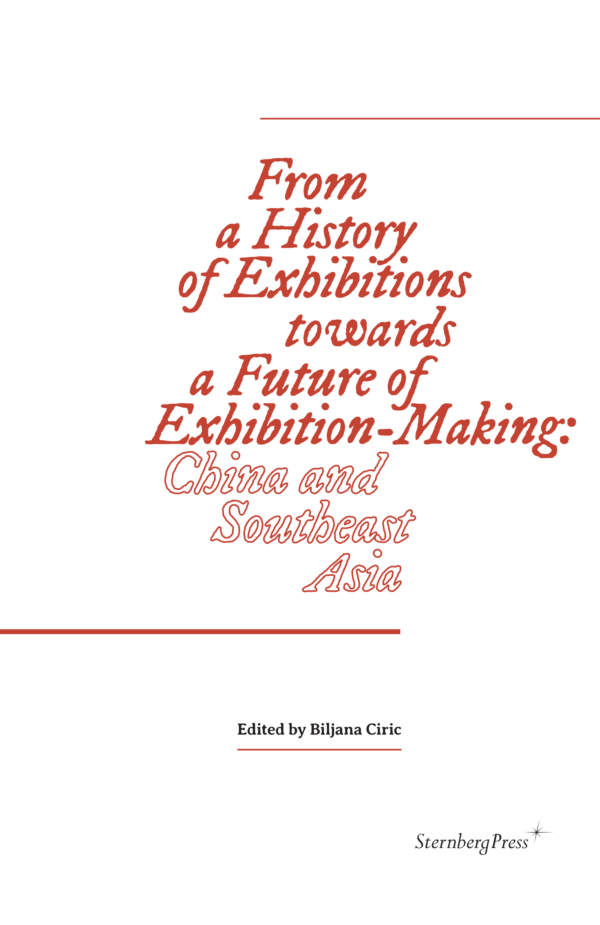
From a History of Exhibitions towards a Future of Exhibition-Making
China and Southeast Asia
Contributions by Zdenka Badovinac, Zoe Butt, Nikita Yingqian Cai, Biljana Ciric, Liu Di, Patrick D. Flores, Erin Glesson, Julia Hartmann, Nathalie Johnson, Carlos Quijon Jr., Jo Lene Ong, Grace Samboh, Alice Sarmiento, Nhung Walsh, Yu Wei, Seng Yujin, Zhong Yuling, Maggie J Zheng, Wang Ziyun
The book From a History of Exhibitions Towards a Future of Exhibition-Making: China and Southeast Asia is the result of various ongoing assembly platforms linked together under the same name, all organized and initiated by Biljana Ciric and hosted by St Paul St Gallery AUT (2013), Rockbund Art Museum (2018), and Guangdong Times Museum (2019). The texts presented in this book are the result of research undertaken by different writers, curators, and art practitioners in Southeast Asia, revisiting the importance of exhibitions as a form and medium presented at assemblies.
The book’s contributions explore how exhibitions can be read and understood across different social and cultural contexts, highlighting differences within the region, whilst also inviting new approaches and methodologies to pinpoint areas for comparative forms of research. The book draws further awareness towards the specificity and diversity of practices found within Asia—thereby looking to contribute decisively towards a (re)mapping of exhibition practices and histories using the different perspectives and local contexts found in this region.
Related Books