| Alex Coles, Catharine Rossi (Eds.)EP Vol. 1
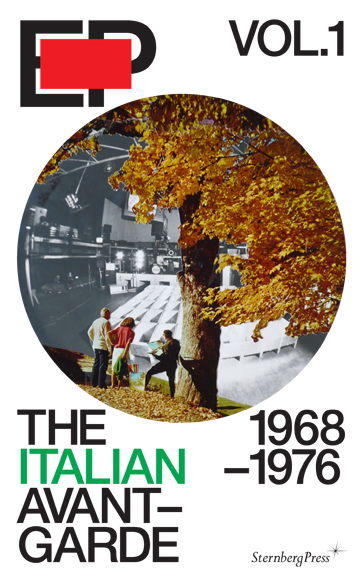
The Italian Avant-Garde: 1968–1976
EP is the first critically underpinned series of publications that fluidly move between art, design, and architecture. The first volume is devoted to the activities of the Italian avant-garde between 1968 and 1976. While emphasizing the multiple correspondences between collectives and groups like Arte Povera, Archizoom, Superstudio, and figures such as Ettore Sottsass and Alessandro Mendini, The Italian Avant-Garde: 1968–1976 also highlights previously overlooked spaces, works, and performances generated by Zoo, Gruppo 9999, and Cavart.
| | Joshua SimonNeomaterialism
Since the so-called dematerialization of currencies and art practices in the late 1960s and early 1970, we have witnessed a move into what Joshua Simon calls an economy of neomaterialism. With this, several shifts have occurred: the focus of labor has moved from production to consumption, the commodity has become the historical subject, and symbols now behave like materials.
| | Gardar Eide EinarssonVersuchsstation des Weltuntergangs
Over the past decade Gardar Eide Einarsson’s exhibition practice has followed a highly consistent thematic trajectory, continuously tracing out what one could call an “iconography of resistance.” The signs and symbols we can read out of Einarsson’s works often refer to fundamental conflictual structures between a society of control following September 11, 2001, and the individual’s rebellion against and threat to central power.
| | Mara Ambrožič, Angela Vettese (Eds.)Art as a Thinking Process
Visual Forms of Knowledge Production
The work of art has often been a battleground—its decorative and formal aspects positioned against its nature as an embodiment of cognitive acts. Leonardo da Vinci’s claim that art be a “cosa mentale” is winning at last: recent debates around art schools and their methods, of which this book is a vast survey, demonstrate that, now more than ever, art is considered the result of a thinking process.
| | Dorothee Böhm, Petra Lange-Berndt, Dietmar Rübel (Eds.)A World of Wild Doubt
The starting point of this exhibition and subsequent publication is the novel The Man Who Was Thursday by British poet G. K. Chesterton from 1908, a mysterious crime story about a seven-headed anarchist council functioning in a world of permanent emergency. Yet in the end, the real danger emanates from artists and intellectuals.
| | Charlotte BirnbaumOn the Table
Pies, Pâtés, and Pastries
Pies, pâtés, and pastries are the noblest of foods. Their inner life is always a secret; their outer form, a sculpture. No other dishes are so well suited to surprises and culinary amusements.
| | T. J. DemosReturn to the Postcolony
Specters of Colonialism in Contemporary Art
In the wake of failed states, growing economic and political inequality, and the ongoing US- and NATO-led wars for resources, security, and economic dominance worldwide, contemporary artists are revisiting former European colonies, considering past injustices as they haunt the living yet remain repressed in European consciousness.
| | Jos de Gruyter & Harald ThysOptimundus
M HKA 08 02 13 - 19 05 13
Jos de Gruyter & Harald Thys’s art casts a merciless perspective on reality. Through their numerous artistic approaches—including installations, video, drawing, sculpture, performance, and photographs—the artist duo visualize their imaginings of the parallel world inherent within the modern human psyche, along with how it manifests itself in the everyday aspects of life and civic conformity. This book accompanies their major exhibition at M HKA of the same title.
| | Marcel Duchamp/Ulf LindeDe ou par Marcel Duchamp par Ulf Linde
Ulf Linde is without doubt one of the world’s most important interpreters of Marcel Duchamp’s art. For more than half a century, he has pursued intense studies of Duchamp’s entire oeuvre and has made perfect replicas of all his major works. His as-yet unpublished manuscript scrutinizing the mathematical principles behind Duchamp’s art reveals what Linde claims to be the key to Duchamp’s poetic universe.
| | Mai Abu ElDahab (Ed.)Behave Like an Audience
Behave Like an Audience is a limited-edition vinyl commissioned and produced by Mai Abu ElDahab, and features musical tracked penned by a group of artists ElDahab worked with at Objectif Exhibitions, Antwerp, and performed by the musical trio Concert.
| | Apolonija ŠušteršičSelected Projects, 1995–2012
Published on the occasion of her project at MUSAC Museo de Arte Contemporáneo in León (January–June 2013), this publication offers the first comprehensive survey on the work of Slovenian artist/architect Apolonija Šušteršič.
| | Clara Meister (Ed.)Compilation of Translations: One Year at Ludlow 38
The publication gives an overview of the 2012 curatorial year at MINI/Goethe-Institut Curatorial Residencies Ludlow 38. Curatorial resident Clara Meister’s program focused on different concepts of translation, bringing together an interdisciplinary exhibition program based on the assumption that artistic ideas can be translated into disparate forms and therefore can take varying modes of expression.
| | Jorge PardoTecoh
Tecoh is a sprawling series of buildings designed by the artist Jorge Pardo deep in the Yucatán jungle. Taking over six years to fabricate, and engaging existing ruins of a nineteenth-century hacienda, the project is by far the artist’s most ambitious work to date. This book offers the only available glimpse of the project, as it was primarily conceived as a private residence.
| | Beatrice GibsonThe Tiger's Mind
In 2010, a production process was instigated by filmmaker Beatrice Gibson and typographer Will Holder, with the intention of using British composer Cornelius Cardew’s musical score The Tiger’s Mind as a means of producing speech. Since the score concerns the changing relations between six characters in production, practitioners from other fields (musicians and visual artists) were invited to three conversations at Künstlerhaus Stuttgart, Kunstverein in Amsterdam, and CAC Brétigny.
| | Sharon LockhartSharon Lockhart | Noa Eshkol
The catalog Sharon Lockhart | Noa Eshkol accompanies the eponymous exhibition at TBA21 in Vienna which consists of a complex installation of videos, photographs, and archival material, composing a subtle and sensuous portrait of the Israeli choreographer, dancer, researcher, and textile artist Noa Eshkol.
| | Stuart Bailey, Angie Keefer, David Reinfurt (Eds.)Bulletins of the Serving Library #4
Devised by Stuart Bailey, Lars Bang Larsen, Angie Keefer, and David Reinfurt, this bulletin is based on Larsen’s just-completed PhD dissertation at the University of Copenhagen, A History of Irritated Material: Psychedelic Concepts in Neo-Avantgarde Art. The idea was to contrive a popular version of his academic thesis by editing it psychedelically.
| | FuturefarmersA Variation on Powers of Ten
A Variation on Powers of Ten uses the opening picnic scene of Charles and Ray Eames’s film Powers of Ten as score to guide ten discussions. The result of a research-based residency at the University of California Berkeley Art Museum and Pacific Film Archive, the publication includes four essays and ten interviews with researchers whose work relates to one of the magnitudes of ten of the 1968 IBM-commissioned film.
| | Ruth BuchananThe weather, a building
This new artist book by Ruth Buchanan charts three narratives associated with the life of the Staatsbibliothek Berlin, which acts as an example of the tension between what is contained in libraries and how it is contained.
| | Markus Miessen, Chantal MouffeCritical Spatial Practice 2
The Space of Agonism
The second volume in the Critical Spatial Practice series presents a selection of conversations between Markus Miessen and political philosopher Chantal Mouffe. The dialogues attempt to unpack current dilemmas and popular mobilizations in terms of consensus-driven formats of political decision making.
| | Lene BergLene Berg
“The work of Lene Berg probes questions about the difference between truth and falsehood, between reality and fantasy, between veracity and mendacity. Berg crafts short, witty, incisive, and often humorous filmic stories, using lo-fi means such as drawing, photocopies, collage, and her own as well as found footage, to interrogate the question of history and historiography,” so states Katerina Gregos. These themes, among others, are explored in Berg’s latest film, Kopfkino (2012), which was filmed over the course of two days in Berlin and focuses on eight women as they exchange stories about their line of work—the fulfillment of sexual fantasies.
| | Katja Gretzinger (Ed.)In a Manner of Reading Design
If design aims at taking a critical stance, it needs to change its acquaintance with knowledge and develop its own discourse to understand the underlying conceptions that are at play. The metaphor of the "blind spot" proposes the perspective of looking at what is implicit or unnoticed in our perception. By doing so, it seeks to open up common readings of what design is and can do. In a Manner of Reading Design features different texts and artistic contributions, opening up a debate that reminds us of our dependence on the other in any conception—and any project design might aspire to.
| | Maria Fusco, Ursula MayerGonda
Gonda, a new book by Ursula Mayer and Maria Fusco, experiments in cinematic and linguistic registers through polyphonic monologue. Taking the form of a ciné-roman, the book is based on Mayer’s 16mm film of the same name, with a screenplay written by Maria Fusco and commissioned by Film London.
| | Jessica WarboysVanelephant
In the fall of 2010, Jessica Warboys discovered photographic portraits of dancer Hélène Vanel in the disused Bibliothèque Smith-Lesouëf, Nogent-sur-Marne. Warboys later discovered an unpublished manuscript by Vanel in the adjoining archives of the Maison nationale des artistes, a retirement home for elderly artists.The artist then translated the texts herself and condensed the drama, and thus shifted Vanel’s role from manuscript to script.
| | Zak KyesZak Kyes Working With...
To accompany his exhibition at the Museum of Contemporary Art Leipzig, this book presents the work of the Swiss-American graphic designer Zak Kyes. In collaboration with the curator, Barbara Steiner, the exhibition and publication bring together a range of works by Kyes, as well as works by a host of collaborators that includes architects, artists, writers, curators, editors, and graphic designers, presenting contemporary graphic design as a practice that mediates, and is mediated by, its allied disciplines.
| | Steve RushtonMasters of Reality
Masters of Reality brings together the first collection of texts by Steve Rushton exploring the interrelations between art, anthropology, social sciences, psychology, media, politics, and economy. Central to Rushton’s research is an investigation into the conception of feedback, social control, and the culture of “self-performance.”
| | Omer Fast5,000 Feet Is the Best
This publication focuses on a single work of art: 5,000 Feet is the Best (2011) by artist Omer Fast. With this cinematic video work, Fast has entered into a discussion about one of the most pressing issues today, namely drone surveillance and warfare—that is, the use of unmanned planes operated by “pilots” on the ground.
| | Isabelle Graw, Daniel Birnbaum, Nikolaus Hirsch (Eds.)Thinking through Painting
Reflexivity and Agency beyond the Canvas
Painting has demonstrated remarkable perseverance in the expanding field of contemporary art and the surrounding ecology of media images. It appears, however, to have dispelled its own once-uncontested material basis: no longer confined to being synonymous with a flat picture plane hung on the wall, today, painting instead tends to emphasize the apparatus of its appearance and the conduits of its circulation.
| | Tirdad ZolghadrPlot
A speculative, existentialist fiction on the melancholia of revolutionary politics and good intentions, Tirdad Zolghadr’s novel is composed of the logorrhea of online communication and unpublished manuscripts. At the start of the New Zion Empire in 2016—a time of unprecedented dystopic stability with superpower coalitions, generous drone regiments, awesome capital investments, and more soft-power propaganda than ever employed in modern history—Sergeant Jim of the United States is taken hostage in Yazd, once the proud seat of the Persian Empire, and becomes a wildly popular mouthpiece for Third World rhetoric, postcolonial jingles, anti-imperial anecdotes, and anti-Zionist mottos.
| | Tom McCarthy, Simon Critchley, et al.The Mattering of Matter
Documents from the Archive of the International Necronautical Society
On August 7, 1999, Tom McCarthy founded the International Necronautical Society (INS) with a public presentation of the "Founding Manifesto," a touchstone that would inform the organization’s proceedings for years to come. Composed of official committee members and illicit “agents,” the INS harks back to early twentieth-century avant-gardes, producing declarations, reports, public hearings, broadcasts, and research documents, as well as orchestrating more covert media infiltrations, all governed by the objective, set out in the "Founding Manifesto," of mapping, entering, and occupying the space of death through literature, philosophy, culture, and technology.
| | Valérie Knoll, Hannes Loichinger, Magnus Schäfer (Eds.)Dealing with—Some Texts, Images, and Thoughts Related to American Fine Arts, Co.
The New York gallery American Fine Arts, Co.—whose name today is largely synonymous with that of its gallerist, Colin de Land (1955–2003)—represents a gallery practice in which a decided deviation from conventional models overlaps with successful activities within the framework of the art market. Faced with the obvious risk of romanticization, it appears all the more important to pursue an understanding of how American Fine Arts, Co. functioned as a gallery.
| | Hito Steyerle-flux journal
The Wretched of the Screen
In Hito Steyerl’s writing we begin to see how, even if the hopes and desires for coherent collective political projects have been displaced onto images and screens, it is precisely here that we must look frankly at the technology that seals them in.
| | Nikolaus Hirsch, Markus Miessen (Eds.)Critical Spatial Practice 1
What Is Critical Spatial Practice?
In September 2011, Nikolaus Hirsch and Markus Miessen invited protagonists from the fields of architecture, art, philosophy, and literature to reflect on the single question of what, today, can be understood as a critical modality of spatial practice.
| | Fabian Marti, Cristina Ricupero (Eds.)Cosmic Laughter No. 1
Beyond the lunatic fringe views regarding the end of the world, a more constructive reading of the phenomenon is found in new age circles claiming that 2012 might be the beginning of a higher consciousness in humanity, coming to the realization that, in fact, Western systems have not brought prosperity and fulfillment to everybody as once imagined.
| | Triple Canopy (Ed.)Invalid Format
An Anthology of Triple Canopy, Vol. 2
Invalid Format is an archive of the widespread publishing activities of Triple Canopy, the editorial collective and online magazine based in New York, Los Angeles, and Berlin. The book explores how works produced for the screen might be transposed to the codex in a way that recalls that former context while also fully inhabiting the page.
| | Beatrice von Bismarck, Jörn Schafaff, Thomas Weski (Eds.)Cultures of the Curatorial
Cultures of the Curatorial assumes a curatorial turn in contemporary cultural practice and discourse. Coming from a variety of disciplines and professional backgrounds, the contributors exemplify the entanglement of theory and practice, consider recent developments within the curatorial field, allow self-reflexive analysis, and explore the conditions—disciplinary, institutional, economic, political, and regional—under which art and culture become public.
| | Stuart Bailey, Angie Keefer, David Reinfurt (Eds.)Bulletins of The Serving Library #3
This issue of Bulletins of the Serving Library doubles as a catalog of sorts to "Ecstatic Alphabets/Heaps of Language," a group exhibition curated by Laura Hoptman at the Museum of Modern Art, New York.
| | Mai Abu ElDahab (Ed.)After Berkeley
Objectif Exhibitions, 2010–2011
Following From Berkeley to Berkeley: Objectif Exhibitions, 2008–2010, this publication is the second in a two-part series of interviews with artists who exhibited at Objectif Exhibitions, Antwerp, between 2010 and 2011. The interviews are accompanied by a collection of secondary and parallel material produced in collaboration with each artist.
| | Keren CytterD.I.E. Now
The True Story of John Webber and His Endless Struggle with the Table of Content
Published on the occasion of the performance of Show Real Drama, this monographic publication concentrates on a performance Keren Cytter developed for If I Can’t Dance, I Don’t Want to be Part of Your Revolution’s edition on Masquerade (2008–10).
| | Jonatan Habib Engqvist, Annika Enqvist, Michele Masucci, Lisa Rosendahl, Cecilia Widenheim (Eds.)Work, Work, Work
A Reader on Art and Labour
What is “work” today and what is its relation to art? What is the position of the artist if “creativity” has become a commodity? How can the artist’s conditions of production be described, and what role can art and architecture play in societal change?
| | Akram ZaatariA Conversation with an Imagined Israeli Filmmaker Named Avi Mograbi
In April 2010, during his residency at Les Laboratoires d’Aubervilliers, Akram Zaatari attempted to write, improvise, and deliver a conversation with an imagined Israeli filmmaker, giving him the name Avi Mograbi. In this conversation, Zaatari revisits photographs he made in his teenage years during the Israeli occupation of his hometown, Saida, in 1982, and imagines what an Israeli filmmaker could have experienced in the same period.
| | Erik Niedling with Ingo NiermannThe Future of Art: A Diary
The Future of Art: A Diary is the sequel to The Future of Art: A Manual (2011), in which Niedling joined Niermann on his search for a new, epic artwork. The book is published on the occasion of the exhibition “18.10.1973–29.02.2012” at the Neues Museum Weimar.
| | Boris Groys (Ed.)e-flux journal
Moscow Symposium
Conceptualism Revisited
Could it be that the Moscow Conceptualists were so elusive or saturated with the particularities of life in a specific economic and intellectual culture that they precluded integration into a broader art historical narrative? If so, then their simultaneously modest and radical approach to form may present a key to understanding the resilience and flexibility of a more general sphere of global conceptualisms that anticipate, surpass, or even bend around their purported origins in canonical European and American regimes of representation, as well as what we currently understand to be the horizon of artistic practice.
| | Johanna Burton, Lynne Cooke, Josiah McElheny (Eds.)CCS Readers: Perspectives on Art and Culture
Interiors
Encounters with art engage various conditions of interiority—whether through psychic spaces or specific physical environments, such as museums and private residences. Through diverse discursive modes—commissioned essays, conversations and talks, historical writings, and artistic projects—this anthology, the first CCS Readers volume, examines the poetics and politics of interior experience within the frame of contemporary art.
| | Juliane RebentischAesthetics of Installation Art
In recent years, debates surrounding the concept of art have focused in particular on installation art, as its diverse manifestations have proven to be incompatible with the modern idea of aesthetic autonomy. Here, Juliane Rebentisch asserts that installation art does not, as is often assumed, dispute aesthetic autonomy per se, and rather should be understood as calling for a fundamental revision of this very concept.
| | Maria Lind (Ed.)Performing the Curatorial
With and Beyond Art
Because the curatorial has clear performative sides, ones that seek to challenge the status quo, it also includes elements of choreography, orchestration, and administrative logistics—like all practices working with defining, preserving, and mediating cultural heritage in a wider sense. Is curating therefore essentially an act of translation? If so, with what purpose, and can it be performed elsewhere?
| | Actors, Agents and AttendantsSocial Housing—Housing the Social: Art, Property and Spatial Justice
Social Housing—Housing the Social: Art, Property and Spatial Justice is the second volume in the Actors, Agents and Attendants series of publications and symposia initiated by SKOR | Foundation for Art and Public Domain to investigate the role of cultural practice in the organization of the public domain.
| | Maria LobodaOh, Wilderness
“Verbal sculptures” and “strange archaeologies”—Maria Loboda’s recent works expose prior events through sparse details of entangled secrets, material contradictions, and masked collusions. Oh, Wilderness demonstrates the artist’s aesthetic equation between language and materiality as it works the other way around, translating materials expressive of a certain weak semiotics to language.
| | Simon Starling / SuperflexReprototypes, Triangulations and Road Tests
Reprototypes, Triangulations and Road Tests brings together seven seminal works by Simon Starling and Superflex in a dialogical setting. These works “collapse” as unstable complexes around pertinent themes whose triangulated speculations are articulated by undisciplined objects, piercing through the layers of time and history and revisiting long-held certainties.
| | Paul Sietsemainterviews on films and works
Published on the occasion of his solo exhibition at Kunsthalle Basel (June–August 2012), this publication includes interviews and images of the work of the Los Angeles-based artist Paul Sietsema.
| | Nikolaus Hirsch, Shveta Sarda (Eds.)Cybermohalla Hub
Cybermohalla Hub, a hybrid of studio, school, archive, community center, library, and gallery is a structure that moves between Delhi and diverse art contexts. The Cybermohalla project, which takes on the meaning of the Hindi word mohalla (neighborhood), has been engaged in rethinking urban life, and reimagining and reanimating the infrastructure of cultural and intellectual life in contemporary cities.
| | Martin BeckThe Aspen Complex
Martin Beck’s exhibition “Panel 2—‘Nothing better than a touch of ecology and catastrophe to unite the social classes…’” draws on the events of the 1970 International Design Conference in Aspen and the development of the Aspen Movie Map to form a visual environment that reflects the interrelations between art, architecture, design, ecology, and social movements. The Aspen Complex documents two versions of Beck’s exhibition, and brings together yet unpublished archival material and new research on the 1970 IDCA and the Aspen Movie Map.
| | Matthias Ulrich (Ed.)Playing the City: Interviews
In Playing the City: Interviews, Matthias Ulrich, curator of the Schirn project, asks fifty-one of the involved artists ten central questions about the participatory and collaborative art context. Their answers and comments provide a telling picture of the multiple forms of interactive, cooperative, and interdisciplinary practices in contemporary art.
| | Yorgos SapountzisA statue has remembered me / Eine Statue hat sich an mich erinnert
Yorgos Sapountzis's work appropriates public space and the statues, monuments, and memorials that inhabit it. The Athens-born artist concentrates less on their historical-political meanings and much more on their function as a medium of recollection. Sapountzis consciously tries to ignore historical information about the sculptures and instead allows them to “speak” through their gestures, poses, and ornaments.
| | Marianne HeierSurplus
Although Marianne Heier abandons the traditional exhibition spaces in connection with her projects, Art with a capital A is still always measured against other social constructs. At this point of intersection, Heier looks at the typical features of the various economies or values of given fields and how they overlap and collide. This project renders visible societal structures and consequences of such structures—of which we are not always aware. By shifting the perspective slightly, we can perhaps glimpse distinct values and new outcomes.
| | Alex ColesThe Transdisciplinary Studio
We have entered a post-post-studio age, and find ourselves with a new studio model: the transdisciplinary. This volume delves into four pioneering transdisciplinary studios—Jorge Pardo Sculpture, Konstantin Grcic Industrial Design, Studio Olafur Eliasson, and Åbäke—by observing and interviewing the practitioners and their assistants.
| | Tobias SpichtigBlue, Red, and Green
The artist book Blue, Red, and Green by Tobias Spichtig is published on the occasion of the exhibition at Ursula Blickle Stiftung, “the blue, the red, the green, the cuboid, and the pyramid.”
| | Eva GrubingerDecoy
Decoy documents the eponymous exhibition at Landesgalerie Linz in 2011 in which Grubinger presented large-scale sculptural works, all of which referenced the fishing—lures, mooring rings, a dock—and both subtly and explicitly engaged a vocabulary of the alluring.
| | bankleerfinger in the pie
This monograph features in depth essays on the collective’s work as well as an annotated image section, which highlights bankleer’s recent projects and deployments.
| | Thomas Keenan, Eyal WeizmanMengele's Skull: The Advent of a Forensic Aesthetics
In 1985, the body of Josef Mengele, one of the last Nazi war criminals still at large, was unearthed in Brazil. The ensuing process of identifying the bones in question opened up what can now be seen as a third narrative in war crime investigations—not that of the document or the witness but rather the birth of a forensic approach to understanding war crimes and crimes against humanity.
| | Charlotte Birnbaum (Ed.)On the Table
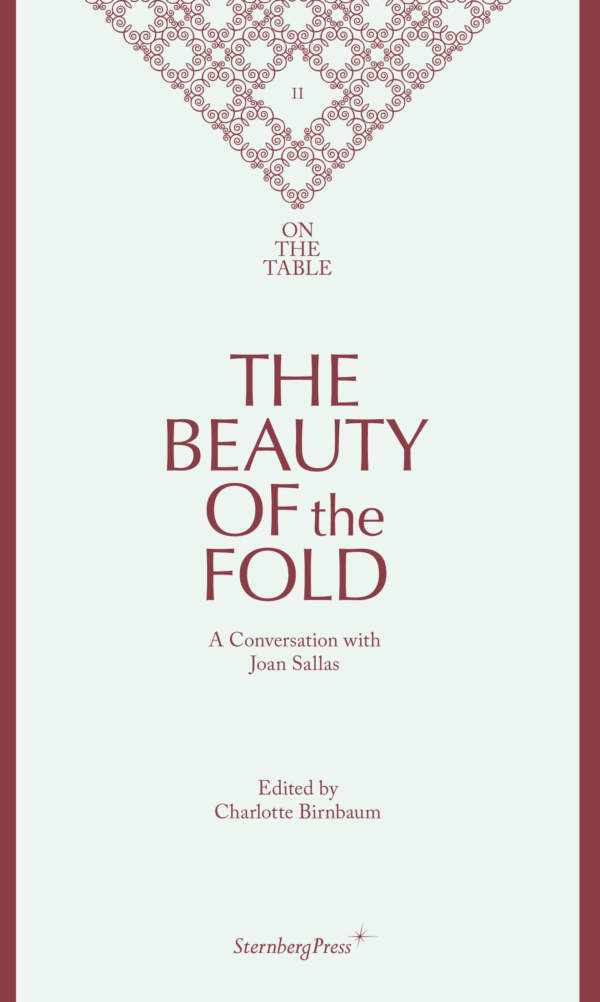
The Beauty of the Fold: A Conversation with Joan Sallas
Joan Sallas, a virtuoso of the fold, has meticulously researched and mastered the history and techniques of the art of the fold. With the banquet table as setting, his expertise and philosophy pour forth in the form of splendid, folded linen.
| | Raimundas MalašauskasPaper Exhibition
Selected Writings by Raimundas Malašauskas
Paper Exhibition is an anthology of writings by curator and writer Raimundas Malašauskas.
| | Carson Chan, Nadim Samman (Eds.)Higher Atlas/Au-delà de l’Atlas
The Marrakech Biennale [4] in Context
The catalogue Higher Atlas/Au-delà de l’Atlas, published on the occasion of the Marrakech Biennale [4], frames the biennial in a historical and theoretical context.
| | Charlotte MothBleckede 2009 / Rochechouart 2011
Charlotte Moth conceived this book as a further elaboration of her artistic practice, linking different projects that have been realized since 2009.
| | Stuart Bailey, Angie Keefer, David Reinfurt (Eds.) Bulletins of The Serving Library #2
The second issue of Bulletins of The Serving Library includes contributions by Dimmi Davidoff, Július Koller, David Fischli & Peter Weiss, Rob Giampietro, Anthony Huberman, Junior Aspirin Records, Perri MacKenzie, David Senior, and Jan Verwoert.
| | Maria Lind, Olav Velthuis (Eds.)Contemporary Art and Its Commercial Markets
A Report on Current Conditions and Future Scenarios
Contemporary Art and Its Commercial Markets maps and analyzes the complex and contested entanglements of contemporary art and its commercial markets.
| | Flaca / Tom Humphreys
Emerging from the eponymous exhibition at Portikus in Frankfurt am Main, Flaca / Tom Humphreys reflects on the London exhibition space, Flaca, that Tom Humphreys organized between 2003 and 2007.
| | Tariq RamadanOn Super-Diversity
Invited to reflect on the notion of “super-diversity,” the acclaimed scholar Tariq Ramadan sets out an argument that foregrounds universalism as a necessary, if devalued, horizon, and offers a critique of the uses and limits of dialogue and discourse within the day-to-day practice of diversity.
| | Eva Grubinger, Jörg Heiser (Eds.)Sculpture Unlimited
Against the historical backdrop of expansions of the notion of sculpture—from Auguste Rodin to Rosalind Krauss and beyond—one could think that the sculptural discipline has become defined by its near arbitrary malleability, since practically anything can be construed as sculpture. Yet interest in the history of sculpture seems to be experiencing a revival, including traditional techniques and production methods, which often appear appealing, even radical, in the age of the Internet and social media.
| | Hassan KhanThe Agreement
Five Stories by Hassan Khan
Artist, writer, and musician Hassan Khan explores the margins at which a vernacular, be it linguistic or formal, attains its stature. Through a series of narrative portraits and accompanying images of his recent sculptures, Khan’s seemingly ubiquitous tales are in fact an attempt to let a story tell itself.
| | Design ActSocially and Politically Engaged Design Today—Critical Roles and Emerging Tactics
Design Act: Socially and Politically Engaged Design Today—Critical Roles and Emerging Tactics is a project that presents and discusses contemporary design practices that engage with political and societal issues.
| | Isabelle Graw, Daniel Birnbaum, Nikolaus Hirsch (Eds.)Art and Subjecthood
The Return of the Human Figure in Semiocapitalism
This book brings together contributions from the eponymous conference, all of which seek to speculate on the reasons as to why, since the turn of the millennium, we have encountered so many artworks that tend to reconcile Minimalism with suggestions of the human figure.
| | Markus Miessen, Andrea Phillips (Eds.)Actors, Agents and Attendants
Caring Culture: Art, Architecture and the Politics of Health
Caring Culture: Art, Architecture and the Politics of Public Health examines changing political uses of the concept of care in neoliberal democracies and asks how artists, architects, and designers both contribute to and attempt to critique its social manifestations.
| | Synne Bull, Marit Paasche (Eds.)Urban Images
Unruly Desires in Film and Architecture
Cinema was the single medium capable of capturing what Alexander Kluge describes as the “the impossible moment”—a moment we couldn’t think of beforehand, and which cannot be repeated later. Thus cinema leads the way to what later becomes reality: to cities, bridges, ideas, gestures, skyscrapers, literature, and art. This anthology traces some of the paths of this “becoming.”
| | Tauba AuerbachFolds
In connection with Tauba Auerbach’s exhibition “Tetrachromat” at Bergen Kunsthall, Folds presents Auerbach’s eponymous painting series for the first time in book form. In these paintings Auerbach twists and folds the canvas before applying the paint. Transferred to the medium of the book, the paintings are presented here in a new and unexpected way alongside mathematical diagrams and three texts.
| | Martti Kalliala with Jenna Sutela and Tuomas ToivonenSolution 239-246
Finland: The Welfare Game
Welcome to Finland, a young land of rapid aging, where newly founded institutions are already outmoded and geographic impediments are a constant crippling agent. As part of Ingo Niermann’s Solution Series, Solution Finland: The Welfare Game by architect Martti Kalliala with writer and curator Jenna Sutela and architect Tuomas Toivonen, addresses the Nordic country’s numerous predicaments.
|
|