Sven LüttickenHistory in Motion
Time in the Age of the Moving Image
The moving image has irrevocably redefined our experience and construction of history. In the contemporary economy of time, history has become an image in motion, a series of events animated and performed through various media. Analyzing a variety of films, video pieces, and performances, Sven Lütticken evaluates the impact that our changing experience of time has had on the actualization of history in the present.
Milena Hoegsberg, Cora Fisher (Eds.)Living Labor
Living Labor considers the increasing subordination of life to work. In response to the eroding boundaries between work and life, and against the historic backdrop of the Scandinavian labor movement, the writers gathered in Living Labor propose viable forms of refusal and imagine prospects for a post-work future.
Undoing Property? examines complex relationships inside art, culture, political economy, immaterial production, and the public realm today. In its pages artists and theorists address aspects of computing, curating, economy, ecology, gentrification, music, publishing, piracy, and much more.
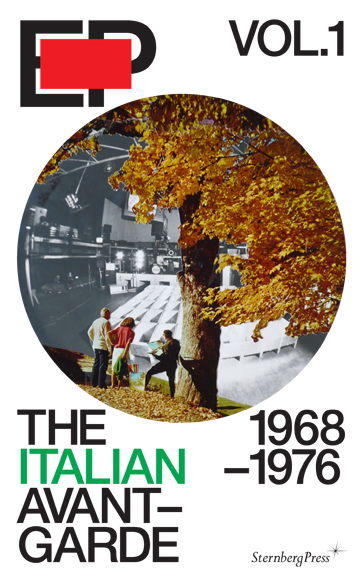
Alex Coles, Catharine Rossi (Eds.)EP Vol. 1
The Italian Avant-Garde: 1968–1976
EPis the first critically underpinned series of publications that fluidly move between art, design, and architecture. The first volume is devoted to the activities of the Italian avant-garde between 1968 and 1976. While emphasizing the multiple correspondences between collectives and groups like Arte Povera, Archizoom, Superstudio, and figures such as Ettore Sottsass and Alessandro Mendini, The Italian Avant-Garde: 1968–1976 also highlights previously overlooked spaces, works, and performances generated by Zoo, Gruppo 9999, and Cavart.
Joanna Warsza (Ed.)Ministry of Highways
A Guide to the Performative Architecture of Tbilisi
Once described as “Italy gone Marxist,” Georgia, located in both an advantageous and vulnerable geopolitical position between the Black Sea, Russia, Central Asia, and the Middle East, enjoys a Mediterranean climate and viniculture in combination with a community-oriented and self-determined spirit. Taking the exhibition “Frozen Moments: Architecture Speaks Back”(2010) as its starting point, this guidebook maps the social, urban, and art discourses of the country’s post-Soviet years as seen from its hilly capital of Tbilisi.
Joshua SimonNeomaterialism
Since the so-called dematerialization of currencies and art practices in the late 1960s and early 1970, we have witnessed a move into what Joshua Simon calls an economy of neomaterialism. With this, several shifts have occurred: the focus of labor has moved from production to consumption, the commodity has become the historical subject, and symbols now behave like materials.
Mara Ambrožič, Angela Vettese (Eds.)Art as a Thinking Process
Visual Forms of Knowledge Production
The work of art has often been a battleground—its decorative and formal aspects positioned against its nature as an embodiment of cognitive acts. Leonardo da Vinci’s claim that art be a “cosa mentale” is winning at last: recent debates around art schools and their methods, of which this book is a vast survey, demonstrate that, now more than ever, art is considered the result of a thinking process.
Thomas Keenan, Tirdad Zolghadr (Eds.)The Human Snapshot
The Human Snapshot draws upon a conference of the same name organized by the LUMA Foundation and Center for Curatorial Studies at Bard College. The conference contributions and subsequent essays examine contemporary forms of humanism and universalism as they circulate and are produced in art and photography.
T. J. DemosReturn to the Postcolony
Specters of Colonialism in Contemporary Art
In the wake of failed states, growing economic and political inequality, and the ongoing US- and NATO-led wars for resources, security, and economic dominance worldwide, contemporary artists are revisiting former European colonies, considering past injustices as they haunt the living yet remain repressed in European consciousness.
Stuart Bailey, Angie Keefer, David Reinfurt (Eds.)Bulletins of the Serving Library #4
Devised by Stuart Bailey, Lars Bang Larsen, Angie Keefer, and David Reinfurt, this bulletin is based on Larsen’s just-completed PhD dissertation at the University of Copenhagen, A History of Irritated Material: Psychedelic Concepts in Neo-Avantgarde Art. The idea was to contrive a popular version of his academic thesis by editing it psychedelically.
Markus Miessen, Chantal MouffeCritical Spatial Practice 2
The Space of Agonism
The second volume in the Critical Spatial Practice series presents a selection of conversations between Markus Miessen and political philosopher Chantal Mouffe. The dialogues attempt to unpack current dilemmas and popular mobilizations in terms of consensus-driven formats of political decision making.
Steve RushtonMasters of Reality
Masters of Reality brings together the first collection of texts by Steve Rushton exploring the interrelations between art, anthropology, social sciences, psychology, media, politics, and economy. Central to Rushton’s research is an investigation into the conception of feedback, social control, and the culture of “self-performance.”
Tom McCarthy, Simon Critchley, et al.The Mattering of Matter
Documents from the Archive of the International Necronautical Society
On August 7, 1999, Tom McCarthy founded the International Necronautical Society (INS) with a public presentation of the "Founding Manifesto," a touchstone that would inform the organization’s proceedings for years to come. Composed of official committee members and illicit “agents,” the INS harks back to early twentieth-century avant-gardes, producing declarations, reports, public hearings, broadcasts, and research documents, as well as orchestrating more covert media infiltrations, all governed by the objective, set out in the "Founding Manifesto," of mapping, entering, and occupying the space of death through literature, philosophy, culture, and technology.
Nikolaus Hirsch, Markus Miessen (Eds.)Critical Spatial Practice 1
What Is Critical Spatial Practice?
In September 2011, Nikolaus Hirsch and Markus Miessen invited protagonists from the fields of architecture, art, philosophy, and literature to reflect on the single question of what, today, can be understood as a critical modality of spatial practice.
Triple Canopy (Ed.)Invalid Format
An Anthology of Triple Canopy, Vol. 2
Invalid Format is an archive of the widespread publishing activities of Triple Canopy, the editorial collective and online magazine based in New York, Los Angeles, and Berlin. The book explores how works produced for the screen might be transposed to the codex in a way that recalls that former context while also fully inhabiting the page.
Beatrice von Bismarck, Jörn Schafaff, Thomas Weski (Eds.)Cultures of the Curatorial
Cultures of the Curatorial assumes a curatorial turn in contemporary cultural practice and discourse. Coming from a variety of disciplines and professional backgrounds, the contributors exemplify the entanglement of theory and practice, consider recent developments within the curatorial field, allow self-reflexive analysis, and explore the conditions—disciplinary, institutional, economic, political, and regional—under which art and culture become public.
Jonatan Habib Engqvist, Annika Enqvist, Michele Masucci, Lisa Rosendahl, Cecilia Widenheim (Eds.)Work, Work, Work
A Reader on Art and Labour
What is “work” today and what is its relation to art? What is the position of the artist if “creativity” has become a commodity? How can the artist’s conditions of production be described, and what role can art and architecture play in societal change?
Erik Niedling with Ingo NiermannThe Future of Art: A Diary
The Future of Art: A Diary is the sequel to The Future of Art: A Manual (2011), in which Niedling joined Niermann on his search for a new, epic artwork. The book is published on the occasion of the exhibition “18.10.1973–29.02.2012” at the Neues Museum Weimar.
Johanna Burton, Lynne Cooke, Josiah McElheny (Eds.)CCS Readers: Perspectives on Art and Culture
Interiors
Encounters with art engage various conditions of interiority—whether through psychic spaces or specific physical environments, such as museums and private residences. Through diverse discursive modes—commissioned essays, conversations and talks, historical writings, and artistic projects—this anthology, the first CCS Readers volume, examines the poetics and politics of interior experience within the frame of contemporary art.
Juliane RebentischAesthetics of Installation Art
In recent years, debates surrounding the concept of art have focused in particular on installation art, as its diverse manifestations have proven to be incompatible with the modern idea of aesthetic autonomy. Here, Juliane Rebentisch asserts that installation art does not, as is often assumed, dispute aesthetic autonomy per se, and rather should be understood as calling for a fundamental revision of this very concept.
Maria Lind (Ed.)Performing the Curatorial
With and Beyond Art
Because the curatorial has clear performative sides, ones that seek to challenge the status quo, it also includes elements of choreography, orchestration, and administrative logistics—like all practices working with defining, preserving, and mediating cultural heritage in a wider sense. Is curating therefore essentially an act of translation? If so, with what purpose, and can it be performed elsewhere?
Actors, Agents and AttendantsSocial Housing—Housing the Social: Art, Property and Spatial Justice
Social Housing—Housing the Social: Art, Property and Spatial Justice is the second volume in the Actors, Agents and Attendants series of publications and symposia initiated by SKOR | Foundation for Art and Public Domain to investigate the role of cultural practice in the organization of the public domain.
Cybermohalla Hub, a hybrid of studio, school, archive, community center, library, and gallery is a structure that moves between Delhi and diverse art contexts. The Cybermohalla project, which takes on the meaning of the Hindi word mohalla (neighborhood), has been engaged in rethinking urban life, and reimagining and reanimating the infrastructure of cultural and intellectual life in contemporary cities.
Martin BeckThe Aspen Complex
Martin Beck’s exhibition “Panel 2—‘Nothing better than a touch of ecology and catastrophe to unite the social classes…’” draws on the events of the 1970 International Design Conference in Aspen and the development of the Aspen Movie Map to form a visual environment that reflects the interrelations between art, architecture, design, ecology, and social movements. The Aspen Complex documents two versions of Beck’s exhibition, and brings together yet unpublished archival material and new research on the 1970 IDCA and the Aspen Movie Map.
Matthias Ulrich (Ed.)Playing the City: Interviews
In Playing the City: Interviews, Matthias Ulrich, curator of the Schirn project, asks fifty-one of the involved artists ten central questions about the participatory and collaborative art context. Their answers and comments provide a telling picture of the multiple forms of interactive, cooperative, and interdisciplinary practices in contemporary art.
Alex ColesThe Transdisciplinary Studio
We have entered a post-post-studio age, and find ourselves with a new studio model: the transdisciplinary. This volume delves into four pioneering transdisciplinary studios—Jorge Pardo Sculpture, Konstantin Grcic Industrial Design, Studio Olafur Eliasson, and Åbäke—by observing and interviewing the practitioners and their assistants.
Thomas Keenan, Eyal WeizmanMengele's Skull: The Advent of a Forensic Aesthetics
In 1985, the body of Josef Mengele, one of the last Nazi war criminals still at large, was unearthed in Brazil. The ensuing process of identifying the bones in question opened up what can now be seen as a third narrative in war crime investigations—not that of the document or the witness but rather the birth of a forensic approach to understanding war crimes and crimes against humanity.
Raimundas MalašauskasPaper Exhibition
Selected Writings by Raimundas Malašauskas
Paper Exhibition is an anthology of writings by curator and writer Raimundas Malašauskas.
Stuart Bailey, Angie Keefer, David Reinfurt (Eds.) Bulletins of The Serving Library #2
The second issue of Bulletins of The Serving Library includes contributions by Dimmi Davidoff, Július Koller, David Fischli & Peter Weiss, Rob Giampietro, Anthony Huberman, Junior Aspirin Records, Perri MacKenzie, David Senior, and Jan Verwoert.
Maria Lind, Olav Velthuis (Eds.)Contemporary Art and Its Commercial Markets
A Report on Current Conditions and Future Scenarios
Contemporary Art and Its Commercial Markets maps and analyzes the complex and contested entanglements of contemporary art and its commercial markets.
Tariq RamadanOn Super-Diversity
Invited to reflect on the notion of “super-diversity,” the acclaimed scholar Tariq Ramadan sets out an argument that foregrounds universalism as a necessary, if devalued, horizon, and offers a critique of the uses and limits of dialogue and discourse within the day-to-day practice of diversity.
Eva Grubinger, Jörg Heiser (Eds.)Sculpture Unlimited
Against the historical backdrop of expansions of the notion of sculpture—from Auguste Rodin to Rosalind Krauss and beyond—one could think that the sculptural discipline has become defined by its near arbitrary malleability, since practically anything can be construed as sculpture. Yet interest in the history of sculpture seems to be experiencing a revival, including traditional techniques and production methods, which often appear appealing, even radical, in the age of the Internet and social media.
Design ActSocially and Politically Engaged Design Today—Critical Roles and Emerging Tactics
Design Act: Socially and Politically Engaged Design Today—Critical Roles and Emerging Tactics is a project that presents and discusses contemporary design practices that engage with political and societal issues.
Markus Miessen, Andrea Phillips (Eds.)Actors, Agents and Attendants
Caring Culture: Art, Architecture and the Politics of Health
Caring Culture: Art, Architecture and the Politics of Public Health examines changing political uses of the concept of care in neoliberal democracies and asks how artists, architects, and designers both contribute to and attempt to critique its social manifestations.
Synne Bull, Marit Paasche (Eds.)Urban Images
Unruly Desires in Film and Architecture
Cinema was the single medium capable of capturing what Alexander Kluge describes as the “the impossible moment”—a moment we couldn’t think of beforehand, and which cannot be repeated later. Thus cinema leads the way to what later becomes reality: to cities, bridges, ideas, gestures, skyscrapers, literature, and art. This anthology traces some of the paths of this “becoming.”
Binna Choi, Axel Wieder (Eds.)Casco Issues XII: Generous Structures
Casco Issues is a magazine published by Casco – Office for Art, Design and Theory, which explores recurring issues that emerge from Casco’s program. The twelfth edition of Casco Issues, Generous Structures, is a playful enquiry into "playfulness" as a value in critical cultural practice. It positions alternative notions of playing against the grain of neoliberal ideologies of "lifelong learning" and "work as play."
Juan A. Gaitán, Nicolaus Schafhausen, Monika Szewczyk (Eds.)Cornerstones
This publication compiles a series of essays on contemporary art written by leading art historians and experts. First presented in lecture format at Witte de With, Center for Contemporary Art, these essays reflect the wealth of the exchange that exists between theoretical writing and artistic thinking, sharing the fascination that each of these authors has with both the work of an artist and how this work functions in relation to larger contexts and broader ideas.
Ingo Niermann with Erik NiedlingThe Future of Art: A Manual
In 1831 Honoré de Balzac wrote a short story, “The Unknown Masterpiece,” in which he invented the abstract painting. Almost 200 years later, writer Ingo Niermann tries to follow in his footsteps to imagine a new epoch-making artwork. Together with the artist Erik Niedling he starts searching for the future of art and, seeking advice, meets key figures of the art world.
Marit Paasche, Judy Radul (Eds.)A Thousand Eyes
Media Technology, Law, and Aesthetics
Through the contribution of internationally renowned artists and scholars, this anthology explores how the aesthetics of new media technology and its spatial implementations affect the judicial system in relation to fundamental concepts such as truth and representation.
Charlotte Birnbaum (Ed.)On the Table
Three Banquets for a Queen
In 1668, Queen Christina of Sweden was greeted in Rome with three spectacular banquets that surpass all historical precedents and successors in the register of extravagant gastronomy. As the first publication of her series, On the Table, Charlotte Birnbaum presents Antonio degli Effetti’s newly translated seventeenth-century text, which elaborately describes the three feasts in all their sumptuous and performative glory.
tranzit.hu (Ed.)Art Always Has Its Consequences
Artists’ Texts from Croatia, Hungary, Poland, Serbia, 1947–2009
Art Always Has Its Consequences is a collection of manifestos, critical texts, and writings addressing public issues written by artists and artist groups from Eastern Europe between 1947 and 2009.
Julieta Aranda, Anton Vidokle, Brian Kuan Wood (Eds.)e-flux journal
Are You Working Too Much?
Post-Fordism, Precarity, and the Labor of Art
When the flexibility, certainty, and freedom promised by being part of a critical outside are considered as extensions of recent advances in economic exploitation, does the field of art then become the uncritical, complicit inside of something far more compelling?
Ewa Lajer-BurcharthChardin Material
Adapted from the lecture she delivered at the Institut für Kunstkritik, Städelschule in Frankfurt am Main, Ewa Lajer-Burcharth’s essay explores the dimension of self-reflexivity in the work of eighteenth-century French painter, Jean-Siméon Chardin.
Armen Avanessian, Luke Skrebowski (Eds.)Aesthetics and Contemporary Art
This inter- and transdisciplinary collection of essays by philosophers, artists, critics, and art historians, reconsiders the place of the aesthetic in contemporary art, with reference to four main themes: aesthetics as “sensate thinking”; the dissolution of artistic limits; post-autonomous practices; and exhibition-values in a global artworld.
MomusSolution 214–238
The Book of Japans
As part of Ingo Niermann’s Solution Series, Solution Japan, or The Book of Japans, makes a case for the rehabilitation of the idea of the “far.” The Book of Japans restores a sense of wonder—along with a plethora of imagination-triggering inaccuracies—by taking the reader on a trip not just through space but also time.
Anton VidokleNew York Conversations
New York Conversations is a text film. Shot in a Chinatown storefront converted for this occasion into an improvised kitchen/restaurant, the film documents three days of public conversations between artists, critics, curators, and a free floating public.
Hans Dickel and Lisa Puyplat (Eds.)Reading Susanne Kriemann
The book is comprised of texts on Susanne Kriemann’s practice and its relation to the concept of Reading in a wider sense: reading photographs, archives, and texts and transforming these into new compositions with photography, urban space, and historiography.
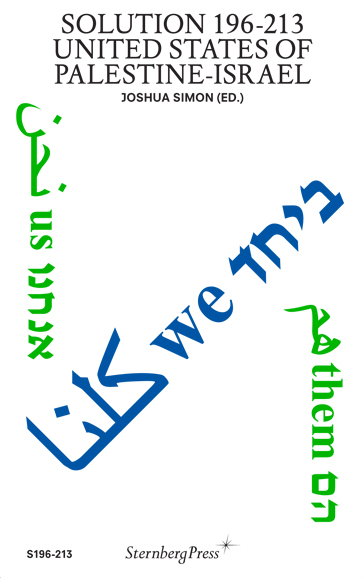
Joshua Simon (Ed.)Solution 196–213
United States of Palestine-Israel
Solution 196–213: United States of Palestine-Israel is an anthology of texts proposing a doable solution for the region. With contributors based in Ramallah and Tel Aviv-Jaffa, Beirut and Jerusalem, New York and Bethlehem, Nazareth and Warsaw, the book offers solutions that will make life better, and proposes ways to do it.
April Lamm (Ed.)Hans Ulrich Obrist
Everything You Always Wanted to Know About Curating*
*But Were Afraid to Ask
Everything you ever wanted to know about Hans Ulrich Obrist but were afraid to ask has been asked by the sixteen practitioners in this book.
Alexis Vaillant (Ed.)Options with Nostrils
Options with Nostrils brings together a collection of previously unpublished essays, both theoretical and visual, by artists, curators, a writer, a scholar, and a group of postgraduates from the Piet Zwart Institute’s Fine Art programme in Rotterdam, who together founded the “Office for the Unknown.”
e-flux journal
Boris GroysGoing Public
As the first in the series of e-flux journal readers to be written by a single author, Going Public brings together a collection of influential essays by Boris Groys.
Maria LindSelected Maria Lind Writing
Selected Maria Lind Writing brings together twenty-two essays selected by Beatrice von Bismarck, Ana Paula Cohen, Liam Gillick, Brian Kuan Wood, and Tirdad Zolghadr.
John KelseyRich Texts
Selected Writing for Art
Compiled for the first time here, the critic, artist, gallerist, dealer, translator John Kelsey’s selected essays gamesomely convey some of the most poignant challenges in the art world and in the many social roles it creates.
Jan VerwoertTell Me What You Want, What You Really, Really Want
Tell Me What You Want, What You Really, Really Want brings together a selection of recent writings by art critic Jan Verwoert for the first time. The book galvanizes central themes Verwoert has been developing in pursuit of a language to describe art’s transformative potential in conceptual, performative, and emotional terms.
Ingo NiermannSolution 186–195
Dubai Democracy
Solution 186–195: Dubai Democracy is the fifth book in the Solution series. Using Dubai as a sort of modernist blank slate for urban and social renewal, author Ingo Niermann confronts today’s most relevant cultural and technological developments with analytical elixirs that are as pertinent as they are unbelievable.
Internal NecessityA Reader Tracing the Inner Logics of the Contemporary Art Field
Internal Necessity was the topic of the Sommerakademie 2009, curated by Tirdad Zolghadr. The result is an independent reader that does not aim to merely document the academy 2009, but reflects and develops its topics in a rich diversity of visual and textual forms.
Jean-Yves LeloupDigital Magma
Writer, DJ, and French sound artist, Jean-Yves Leloup has followed the evolution of electronic music from its first appearance in Europe at the end of the eighties. A fortunate witness to the electronic scene, he is also interested in all questions relative to contemporary art and digital technologies.
Julieta Aranda, Brian Kuan Wood, Anton Vidokle (Eds.)e-flux journal
What Is Contemporary Art?
E-flux journal: What Is Contemporary Art? puts the apparent simplicity and self-evident term into doubt, asking critics, curators, artists, and writers to contemplate the nature of this catchall or default category.
Daniel Birnbaum, Isabelle Graw (Eds.)The Power of Judgment
A Debate on Aesthetic Critique
Comprised of a lecture by Christoph Menke and two respective responses to it by Daniel Loick and Isabelle Graw, The Power of Judgment both attests to the importance of judgment in art criticism and argues against its determining verdicts.
Nav Haq, Tirdad Zolghadr (Eds.)Lapdogs of the Bourgeoisie
Class Hegemony in Contemporary Art
Class inevitably raises awkward questions for the protagonists of contemporary art—about their backgrounds, patrons, and ideological partialities. Lapdogs of the Bourgeoisie investigates this latent yet easily overlooked issue, which has been historically eclipsed by gender, sexuality, ethnicity, and nationality.
Tirdad ZolghadrSolution 168–185
America
Solution 168-185: America is the fourth book in the Solution series. Opting for the United States of America—which the author says is “still the most proficiently colonial place” [he knows]—Tirdad Zolghadr provides a compilation of highly entertaining “solutions” for a nation suspicious of progressive politics yet rich in its history of harboring and cultivating the avant-garde.
Peter FriedlSecret Modernity
Selected Writings and Interviews 1981–2009
Since the early 1980s, Friedl has written on a variety of subjects. The book Secret Modernity: Selected Writings and Interviews 1981–2009 compiles for the first time a representative selection of his (partly unpublished) texts, along with a series of interviews.
Peter FriedlDie heimliche Moderne
Ausgewählte Texte und Interviews 1981–2009
Die heimliche Moderne brings together a collection of Friedl’s writings and interviews from 1981–2009. It is available in both English and German editions.
Dieter Daniels, Gunther Reisinger (Eds.)Net Pioneers 1.0
Contextualizing Early Net-Based Art
Net Pioneers 1.0 discusses media art history with a new, interdisciplinary look at the historical, social, and economic dynamics of our contemporary, networked society.
Isabelle GrawHigh Price
Art Between the Market and Celebrity Culture
Today, the art world is not dominated by a small group of insiders. According to Graw, the art economy has been transformed from a retail business into an industry that produces visuality and meaning. Written during both the height of the most recent art boom in early 2008 and its sudden collapse thereafter, High Price upholds a unique position towards the art world's inner contradictions between symbolic meaning and monetary value.
Joseph GrigelyExhibition Prosthetics
Exhibition Prosthetics by Joseph Grigely is the first in the Bedford Press Editions series of artists’ books edited by Zak Kyes. The series will engage with publications as a primary medium of practice, enabling artists to explore the inherent constraints and possibilities of the printed document.
Bettina FunckePop or Populus
Art Between High and Low
The alienation between modern high culture and its public is a fundamental conflict of art. This book develops a theory of contemporary art in response to our moment, when artists and critics must respond to art’s unprecedented popularity.
Magnus Ericson, Martin Frostner, Zak Kyes, Sara Teleman, Jonas Williamsson (Eds.)Iaspis Forum on Design and Critical Practice
The Reader
What happens when you look at design as some thing more than a service-based relationship between client and designer? What new strategies and models help to question and challenge the limits of design? What outer circumstances influence this kind of practice?
Julieta Aranda, Anton Vidokle, Brian Kuan Wood (Eds.)e-flux journal reader 2009
The selection of essays included in this book seeks to highlight an ongoing topical thread that ran throughout the first eight issues of e-flux journal. It aims at providing a fresh approach to the function of an art journal as something that situates the multitude of what is currently available, and makes that available back to the multitude.
Céline CondorelliSupport Structures
Support Structures is a manual for what bears, sustains, and props, for those things that encourage, care for, and assist; for that which advocates, articulates; for what stands behind, frames, and maintains: it is a manual for those things that give support.
Sylvère Lotringer (Ed.)The German Issue
I like to stand with one leg on each side of the wall. Maybe this is a schizophrenic position, but none other seems to me real enough. —Heiner Müller, The German Issue
Nikolaus Hirsch, Wolfgang Lorch, Andrea Wandel (Eds.)Gleis 17/Track 17
“Crimes against humanity,” especially genocide, have been excluded from amnesty since the Nuremburg Trials. On a cultural level, oblivion by decree becomes an obligation to remember. This reversal is well-intended, but it opens up critical questions: Can memory be permanently established? Is it possible to maintain it in a monument?
Nikolaus Hirsch, Philipp Misselwitz, Markus Miessen, Matthias Görlich (Eds.)Institution Building
Artists, Curators, Architects in the Struggle for Institutional Space
This book presents a study that conceptualizes, tests, and practically applies the spatial strategy for the European Kunsthalle. The investigation is the result of the activities incorporated into a two-year work practice from 2005 to 2007, an iterative “applied research” informed by resonances between theory and practice.
Cecilia Widenheim (Ed.)Voice Over
On Staging and Performative Strategies in Contemporary Art
Voice Over examines staging, theatricality, and performative strategies in contemporary art practices. With contributions by the artists Miriam Bäckström, Goldin+Senneby, Saskia Holmkvist, Fia-Stina Sandlund, and Geist magazine, an essay by curator and writer Anselm Franke, and an introduction by Cecilia Widenheim.
Sven LüttickenIdols of the Market
Modern Iconoclasm and the Fundamentalist Spectacle
This book reexamines the legacies of modern theoretical and artistic iconoclasm in the context of the current religious-political image wars.
Ingo NiermannSolution 1–10
Umbauland
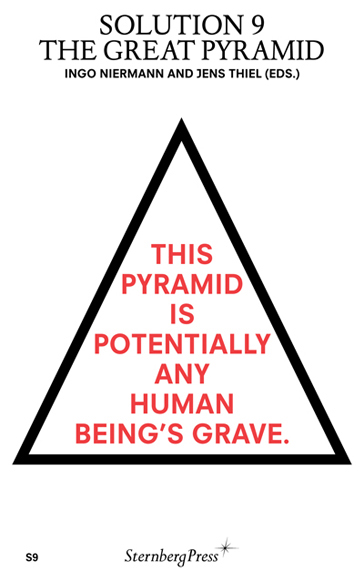
In Solution 1-10: Umbauland, Ingo Niermann devises ten provokingly simple ideas which would see Germany work it out after all, including a new grammar, a new political party, assigning allotment gardens to unemployed people and retirees, and the Great Pyramid, the tallest building of the world which would serve as a democratic tomb for millions of people.
Nicolas BourriaudThe Radicant
In his most recent essay, Nicolas Bourriaud claims that the time is ripe to reconstruct the modern for the specific context in which we are living. If modernism was a return to the origin of art or of society, to their purification with the aim of rediscovering their essence, then our own century’s modernity will be invented, precisely, in opposition to all radicalism, dismissing both the bad solution of re-enrooting in identities as well as the standardization of imaginations decreed by economic globalization.
MomusSolution 11–167
The Book of Scotlands
At a time when functional independence seems to be a real possibility for Scotland—and yet no one is quite sure what that means—a delirium of visions, realistic and absurd, is necessary.
Daniel Birnbaum, Anders OlssonAs a Weasel Sucks Eggs
An Essay on Melancholy and Cannibalism
As a Weasel Sucks Eggs examines the enigmatic relation of melancholia to an early kind of cannibalism, which psychoanalysis, in particular, stressed. It contains readings of, amongst others, Franz Kafka, Samuel Beckett, Thomas Bernhard, Sigmund Freud, G. W. F. Hegel, and the Swedish poet Gunnar Ekelöf.
Markus Miessen (Ed.)East Coast Europe
“East Coast Europe,” which took place during Spring 2008, is a project about the perceptions of contemporary European identity and its relation to spatial practices and international politics.
Diedrich DiederichsenOn (Surplus) Value in Art
Drawing on fresh readings of Marxist and postmodern thought, renowned German cultural critic Diedrich Diederichsen compares the abstract and climbing values of artworks with the plunging value of music—a traditionally immaterial art—in order to formulate a broad reflection on the current “crisis of value in the arts.”
Maria Lind, Hito Steyerl (Eds.)The Greenroom
Reconsidering the Documentary and Contemporary Art #1
Documentary practices make up one of the most significant and complex tendencies within art during the last two decades. This anthology seeks to overcome the existing dispersion of texts on these practices and offer new perspectives on this crucial theme.
Daniel Birnbaum, Isabelle Graw (Eds.)Canvases and Careers Today
Criticism and Its Markets
Canvases and Careers Today brings together contributions from the eponymous conference organized by the Institut für Kunstkritik, Frankfurt am Main. Its goal is to provide deeper insights and more complexity to current debates on the relationship between criticism, art, and the market.
Ingo Niermann, Jens Thiel (Eds.)Solution 9
The Great Pyramid
German entrepreneurs are planning to outstrip the ancient Egyptians by building the world’s largest pyramid on a derelict site in eastern Germany – which they claim will eventually contain the remains of millions of people in concrete burial blocks. The Independent
Jörg HeiserAll of a Sudden
Things that Matter in Contemporary Art
Since the mid-1990s, contemporary art has been booming like never before. There is more of everything—more artists, more collectors, more galleries, more art fairs, more museums, more biennials … with one exception: criteria with which the art of the moment can be understood, judged, praised and, if need be, damned.
Daniel BirnbaumThe Hospitality of Presence
Daniel Birnbaum’s The Hospitality of Presence is a study of the concept of otherness in Edmund Husserl’s phenomenology. In the late 1990s it gained international attention in academic circles. It was reviewed favorably in specialized philosophy journals such as Review of Metaphysics and quoted extensively, most notably by Paul Ricoeur in one of the legendary French thinker’s last books.
Joseph Backstein, Daniel Birnbaum, Sven-Olov Wallenstein (Eds.)Thinking Worlds
The Moscow Conference on Philosophy, Politics, and Art
Thinking Worlds brings together contributions from a two-stage symposium organized in connection with the 2nd Moscow Biennial of Contemporary Art. These essays address questions of the sense and purpose of the “event” in contemporary artistic culture, of the current status of philosophy and aesthetic theory, and of the political significance of artistic interventions.
Daniel Birnbaum, Isabelle Graw (Eds.)Under Pressure
Pictures, Subjects, and the New Spirit of Capitalism
Under Pressure gathers together the contributions to the same-titled conference held at the Institut für Kunstkritik from 2006–07.
Markus Miessen (Ed.)The Violence of Participation
Europe, as a political space, is as conflictual as its constitution. It needs to be designed and negotiated. It is longing for an architecture of strategic encounters. Based on the curation of a space at the 2007 Lyon Biennial, London-based architect and writer Markus Miessen has drawn together a group of people to lead conversations around alternative notions of participation, the clash of democratic heterogeneities, and what it means to live in Europe today.
Julia Moritz, Nicolaus Schafhausen (Eds.)Die Frage des Tages / The Question of the Day
With its 100 questions and answers from major practitioners of the art world and beyond, this book helps to examine the various parameters for a new institutional model.
Nikolaus HirschOn Boundaries
In several theoretical essays, dialogues on collaborative projects and reflections on his own work, the architect Nikolaus Hirsch explores the critical transformations of contemporary space and its effects on spatial practice.
Ina BlomOn the Style Site
Art, Sociality, and Media Culture
While style has all but disappeared from art historical and art critical discourse, artistic practice since the 1960’s onwards has seemed increasingly focused on the stylistics of the life-environment, the way in which everyday life itself is formed, designed or stylized. This development calls for a new reading of the relationship between art and the question of style, one that approaches the question of style itself not just as an art historical “tool” or method of explanation but as a social site in which relations between appearance, recognition and social identity is negotiated.
Daniel BirnbaumChronology
With a Special Project by Paul Chan
In these multiple excursions through recent artist film-installations, Daniel Birnbaum pursues a problem that preoccupied Deleuze in post-war cinema: what is the logic of this peculiar time “after finitude”, based neither in God nor Man, salvation nor destiny; and what does it mean for our brains and our lives to invent new ways to make it visible? With a light wry wit, he thus renews a question, at once aesthetic and philosophical, still very much with us. John Rajchman, Philosopher, Columbia University
Łukasz Ronduda, Florian Zeyfang (Eds.)1,2,3… Avant-Gardes
Film/Art between Experiment and Archive
1,2,3… Avant-Gardes is dedicated to the ongoing history of the experiment in film and art. This book describes and analyses the works of filmmakers and artists, defining two decades of experiments in Polish avant-garde film, and juxtaposes their work with contributions by international artists, who started to work during the last fifteen years.
Noah Horowitz, Brian Sholis (Eds.)The Uncertain States of America Reader
The Uncertain States of America Reader constitutes a unique compilation of writing around art and cultural politics in America since 2000.
Tanya Leighton (Ed.)In The Poem About Love You Don't Write The Word Love
This book provides a theoretical and critical framework for examining how contemporary art and cinema can still hold out against an experience of vision and of the “visual.”
Will Bradley, Mika Hannula, Cristina Ricupero, Superflex (Eds.)Self-Organisation / counter-economic strategies
This book is about the many approaches to the creation, dissemination and maintenance of alternative, “bottom-up” models for social or economic organisation, and the practical and theoretical implications, consequences and possibilities of these self-organised structures.
Hans Ulrich Obrist...dontstopdontstopdontstopdontstop
On closer inspection ... the book covers a dizzying range of subjects, many of them spinning outwards from salient Obristian themes such as artistic collaboration, visionary architecture ("Cedric Price; Curating with Light Luggage"), ecology and waste ("Cloaca Maxima"), and economic development in the Far East ("Cities on the Move") and yet, as if the synthesis of some kind of intellectual centrifuge or particle accelerator experiment, always crystallizes around issues concerning museology and the display reception and discussion of art. Dan Fox, frieze
Daniel BirnbaumChronology
A philosophical essay on time, phenomenology and beyond, Daniel Birnbaum’s Chronology was presented in frieze as a “compelling and sophisticated take on the common theme of Deleuzian immanence."
Melik OhanianCosmograms
Contributions by Cecil Balmond, Gilles Clément, Beatriz Colomina, Tacita Dean, Richard Drayton, David Elbaz, Patricia Falguières, Medard Gabel, André Gaudreault, Paul Gilroy, Edouard Glissant, Anna Halprin, David Held, Pekka Himanen, Bruno Latour, Charles Musser, Jean-Luc Nancy, Jane Poynter, Jean-Christophe Royoux, Saskia Sassen, Peter Sloterdijk, John Tresch, Eduardo Viveiros de Castro, and Robert Whitman
Nicolas BourriaudPostproduction
Postproduction. Culture as Screenplay: How Art Reprograms the World is the most recent essay by French writer and curator Nicolas Bourriaud.
Cristina Ricupero, Lars Bang Larsen, Nicolaus Schafhausen (Eds.)The Populism Reader
The Populism Reader accompanies Populism, an exhibition project in four European cities (Vilnius, Oslo, Amsterdam, Frankfurt am Main) exploring the relationships between contemporary art and current populist cultural and political trends.
Charlotte Brandt, Lars Bang Larsen, Jean-Charles Massera, Cristina Ricupero (Eds.)Fundamentalisms of the New Order
Conceived as a textbook with images rather than an exhibition catalogue, the book reflects on the diversity of fundamentalisms, a phenomenon that is not confined to particular cultures or modes of thought; its intention is to explore the concept in its many forms and multiple origins.
Gerard ByrneBooks, Magazines, and Newspapers
In his seminal essay, author George Baker links Gerard Byrne’s work to theater and notes that the presence of avant-garde dramatist Bertolt Brecht has never been less discussed, but more widely explored, than in the last decade of artistic practice.
AdornoThe Possibility of the Impossible (Vol. I)
Adorno. The Possibility of the Impossible (Vol. I) comprises theoretical essays which investigate the relevance of Adorno’s critical theory for the present.
AdornoThe Possibility of the Impossible (Vol. II)
Adorno. The Possibility of the Impossible (Vol. II) documents the Adorno exhibition which looks at the connection between contemporary art and Adorno’s writings, with the visual arts becoming a central platform for comparison to Adorno’s main subjects.
Jean-Charles MasseraSex, Art, and the Dow Jones
How can the events in which we are supposed to participate be translated into experience? How can we represent ourselves in a History that is being written in terms of the economy and the stock market? Along these questions, French author Jean-Charles Massera discusses the works of various artists (Vito Acconci, Stan Douglas, Felix Gonzalez-Torres, Pierre Huyghe, et al.) and film-makers (Jean-Luc Godard, Wong Kar-wai, Nanni Moretti, Pier Paolo Pasolini, et al.).
Anthony VidlerUnheimlich
Über das Unbehagen in der modernen Architektur
Anthony Vidler interprets contemporary buildings and projects in light of the uncanny as a metaphor for a fundamentally “unhomely” modern condition.
Nicolaus Schafhausen (Ed.)Neue Kunstkritik
Neue Kunstkritik (New Art Criticism) documents a symposium held at the Frankfurter Kunstverein in September 1999.
Harun FarockiNachdruck / Imprint
Texte / Writings
“Nachdruck / Imprint” brings together a selection of writings produced by Harun Farocki over the past three decades. They provide an insight into Farocki’s filmic work and its underlying querying of the status, production, and perception of images conveyed technically and through media.
Eva Grubinger group.sex
The texts in group.sex discuss political groups and languages, abstract radicalism and art, feminism and bohemianism, social hierarchies, and telematic friendship.