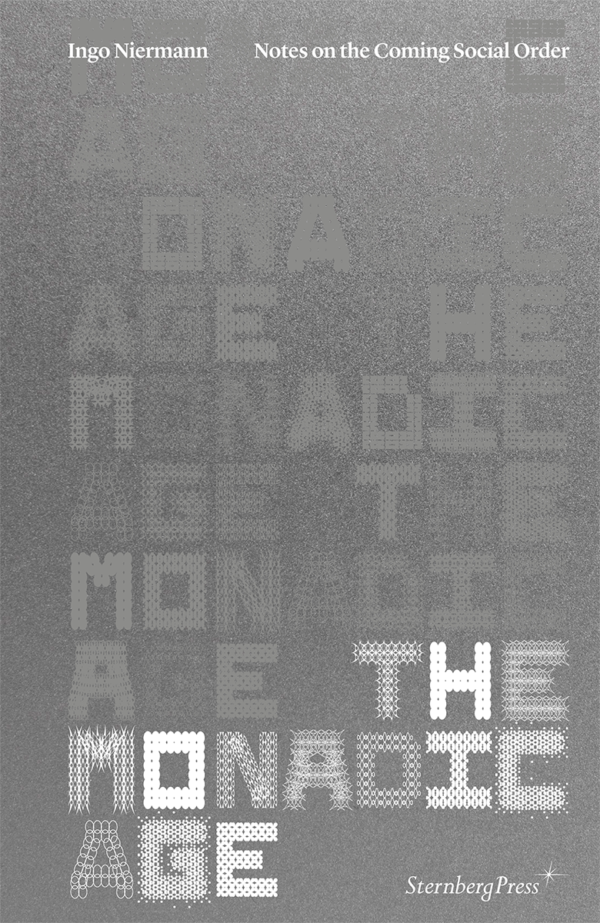
Ingo Niermann
Solution 186–195
Dubai Democracy
Magnus af Petersens (Ed.)
Keren Cytter
Jean-Yves Leloup
Digital Magma
Angelika Burtscher, Judith Wielander (Eds.)
visible
“where art leaves its own field and becomes visible as part of something else”
Silberkuppe
Under One Umbrella
BLESS
Retroperspective Home N° 30 – N° 41
Julieta Aranda, Brian Kuan Wood, Anton Vidokle (Eds.)
e-flux journal
What Is Contemporary Art?
Daniel Birnbaum, Isabelle Graw (Eds.)
The Power of Judgment
A Debate on Aesthetic Critique
Auguste Orts
Correspondence
Moyra Davey
Speaker Receiver
Nav Haq, Tirdad Zolghadr (Eds.)
Lapdogs of the Bourgeoisie
Class Hegemony in Contemporary Art
Haegue Yang
Siblings and Twins
Raqs Media Collective
Seepage
Julika Rudelius
Soft Intrusion
Tirdad Zolghadr
Solution 168-185
America
Peter Friedl
Secret Modernity
Selected Writings and Interviews 1981–2009
Peter Friedl
Die heimliche Moderne
Ausgewählte Texte und Interviews 1981–2009
Anselm Franke (Ed.)
Animism (Volume I)
Agnieszka Brzezanska
L’artiste, le modèle et la peinture
Dieter Daniels, Gunther Reisinger (Eds.)
Net Pioneers 1.0
Contextualizing Early Net-Based Art
Isabelle Graw
High Price
Art Between the Market and Celebrity Culture
Joseph Grigely
Exhibition Prosthetics
Bettina Funcke
Pop or Populus
Art Between High and Low
Magnus Ericson, Martin Frostner, Zak Kyes, Sara Teleman, Jonas Williamsson (Eds.)
Iaspis Forum on Design and Critical Practice
The Reader
Friedrich Kunath
Home wasn’t built in a day
The Otolith Group
A Long Time Between Suns
Helke Bayrle
Portikus Under Construction
Dominic Eichler
Written All Over Us
Dexter Sinister
Portable Document Format
Julieta Aranda, Anton Vidokle, Brian Kuan Wood (Eds.)
e-flux journal reader 2009
Céline Condorelli
Support Structures
Sylvère Lotringer (Ed.)
The German Issue
Diango Hernández
Losing You Tonight
Anton Vidokle
Produce, Distribute, Discuss, Repeat
Nikolaus Hirsch, Wolfgang Lorch, Andrea Wandel (Eds.)
Gleis 17/Track 17
Jean-Luc Blanc
Opera Rock
Dave Hullfish Bailey
What’s Left
Momus
Solution 11-167
The Book of Scotlands
Sabine Bitter & Helmut Weber
Autogestion, or Henri Lefebvre in New Belgrade
Nikolaus Hirsch, Philipp Misselwitz, Markus Miessen, Matthias Görlich (Eds.)
Institution Building
Artists, Curators, Architects and the Struggle for Institutional Space
Cecilia Widenheim (Ed.)
Voice Over
On Staging and Performative Strategies in Contemporary Art
Mike Bouchet
Selected Works 1989-2009
Jörg Heiser (Ed.)
Fare una scenata / Making a Scene
Liam Gillick
How Are You Going to Behave? A Kitchen Cat Speaks/
Wie würden Sie sich verhalten? Eine Küchenkatze spricht
Loris Gréaud
Trajectories and Destinations
Volume 1
Sven Lütticken
Idols of the Market
Modern Iconoclasm and the Fundamentalist Spectacle
Ingo Niermann
Solution 1-10
Umbauland
Simon Dybbroe Møller
Kompendium
Nicolas Bourriaud
The Radicant
Klaus Weber
Large Dark Wind Chime (Tritone Westy)
Justine Frank
Roee Rosen
Sweet Sweat
Olaf Holzapfel
Nakano Sakaue
Verhandelte Zeichen
Klaus Weber
Secession
Ian Wallace
A LIterature of Images
Daniel Birnbaum, Anders Olsson
As a Weasel Sucks Eggs
An Essay on Melancholy and Cannibalism
Agnieszka Kurant
Unknown Unknown
Antje Majewski
My Very Gestures
Markus Miessen (Ed.)
East Coast Europe
Diedrich Diederichsen
On (Surplus) Value in Art
Keren Cytter
The seven most exciting hours of Mr. Trier’s life in twenty-four chapters
M/M (Paris)
Live Recorded Delay
An Archive of “Il Tempo del Postino”
Alexis Vaillant (Ed.)
Légende
Maria Lind, Hito Steyerl (Eds.)
The Greenroom
Reconsidering the Documentary and Contemporary Art #1
Daniel Birnbaum, Isabelle Graw (Eds.)
Canvases and Careers Today
Criticism and Its Markets
Ingo Niermann, Jens Thiel (Eds.)
Solution 9
The Great Pyramid
Mariana Castillo Deball
These Ruins You See / Estas ruinas que ves
Jörg Heiser
All of a Sudden
Things that Matter in Contemporary Art
Daniel Birnbaum
The Hospitality of Presence
Joseph Backstein, Daniel Birnbaum, Sven-Olov Wallenstein (Eds.)
Thinking Worlds
The Moscow Conference on Philosophy, Politics, and Art
Daniel Birnbaum, Isabelle Graw (Eds.)
Under Pressure
Pictures, Subjects, and the New Spirit of Capitalism
Nomeda & Gediminas Urbonas
Villa Lituania
Perros Negros, Toasting Agency (Eds.)
Otra de vaqueros
Michael Sailstorfer
Reaktor
Markus Miessen (Ed.)
The Violence of Participation
Julia Moritz, Nicolaus Schafhausen (Eds.)
Die Frage des Tages / The Question of the Day
Peter Friedl
Working at Copan / Trabalhando no Copan
Nikolaus Hirsch
On Boundaries
Bernadette Corporation
Eine Pinot Grigio, Bitte
Ina Blom
On the Style Site
Art, Sociality, and Media Culture
Mariana Castillo Deball, Irene Kopelman (Eds.)
A for Alibi
Daniel Birnbaum
Chronology
With a Special Project by Paul Chan
Łukasz Ronduda, Florian Zeyfang (Eds.)
1,2,3… Avant-Gardes
Film/Art between Experiment and Archive
Noah Horowitz, Brian Sholis (Eds.)
The Uncertain States of America Reader
Aleksandra Mir
The Meaning of Flowers
Manuel Raeder
Popurri: Agenda 2007
Tanya Leighton (Ed.)
In The Poem About Love You Don't Write The Word Love
Will Bradley, Mika Hannula, Cristina Ricupero, Superflex (Eds.)
Self-Organisation / counter-economic strategies
Jean-Max Colard, Thomas Lélu (Eds.)
After
Bik Van der Pol
Fly Me To The Moon
Desiree Heiss, Ines Kaag, Manuel Raeder (Eds.)
BLESS. Celebrating Ten Years of Themelessness: N° 00 – N° 29
Jennifer Higgie
Bedlam
Katja Eydel (Ed.)
Model ve Sembol. The Invention of Turkey
Josephine Meckseper
The Josephine Meckseper Catalogue No. 2
Tue Greenfort
Photosynthesis
Hans Ulrich Obrist
...dontstopdontstopdontstopdontstop
Michael Beutler
Pecafil
Christopher Williams
Program. For Example: Dix-Huit Leçons Sur La Société Industrielle (Revision I)
Daniel Birnbaum
Chronology
Rirkrit Tiravanija, PLAN.b Publishing
oVER
Lars Bang Larsen, Cristina Ricupero, Nicolaus Schafhausen (Eds.)
The Populism Catalogue
Antje Majewski, Ingo Niermann (Eds.)
Skarbek
Keren Cytter
The Man Who Climbed Up the Stairs of Life and Found Out They Were Cinema Seats
Anke Kempkes, Kunsthalle Basel (Ed.)
Flesh at War with Enigma
Melik Ohanian
Cosmograms
Diango Hernández
revantgarde
Nicolas Bourriaud
Postproduction
Alex Morrison
Giving the Story a Treatment
Cristina Ricupero, Lars Bang Larsen, Nicolaus Schafhausen (Eds.)
The Populism Reader
Jacob Fabricius (Ed.)
The Danish Pavilion – 51st Venice Biennale
M/M (Paris)
Le Grand Livre
Josephine Meckseper
The Josephine Meckseper Catalogue
Charlotte Brandt, Lars Bang Larsen, Jean-Charles Massera, Cristina Ricupero (Eds.)
Fundamentalisms of the New Order
Cerith Wyn Evans
“Cerith Wyn Evans”
Andrew Lee Walker, Rachel K. Ward (Eds.)
Terminal 5
Markus Heinzelmann, Nicolaus Schafhausen (Eds.)
Markus Schinwald
Antje Majewski, Ingo Niermann (Eds.)
Atomkrieg
Peter Friedl
Four or Five Roses
Vanessa Joan Müller and Nicolaus Schafhausen (Eds.)
Bernhard Willhelm
Gerard Byrne
Books, Magazines, and Newspapers
Adorno
The Possibility of the Impossible (Vol. I)
Adorno
The Possibility of the Impossible (Vol. II)
Thomas Eggerer
Atrium
Michaela Melián
Triangel
Jean-Charles Massera
Sex, Art, and the Dow Jones
John Kelsey, Aleksandra Mir (Eds.)
Corporate Mentality
Lars Bang Larsen (Ed.)
Sture Johannesson
Nicolaus Schafhausen (Ed.)
deutschemalereizweitausenddrei
Marcel Odenbach
Blenden/Blinds
Julia Scher
Always There
Lolita Jablonskiene, Nicolaus Schafhausen (Eds.)
Changing Society: Lithuania
Kai Althoff
Gebärden und Ausdruck
Nicolaus Schafhausen (Ed.)
Non-Places
Anthony Vidler
Unheimlich
Über das Unbehagen in der modernen Architektur
Nicolaus Schafhausen (Ed.)
Neue Kunstkritik
Nicolaus Schafhausen (Ed.)
Neue Welt
Karl-Heinz Kohl, Nicolaus Schafhausen (Eds.)
New Heimat
Harun Farocki
Nachdruck / Imprint
Texte / Writings
Isa Genzken
Urlaub
Liam Gillick
five or six
Tom Burr
Low Slung
Jeroen de Rijke / Willem de Rooij
After the Hunt
Susanne Gaensheimer, Nicolaus Schafhausen (Eds.)
Liam Gillick
Eva Grubinger
group.sex

 
Nomeda & Gediminas UrbonasVilla Lituania

Edited by Simon Rees
Texts by David Carrier, Boris Kagarlitsky, Viktor Misiano, Julian Stallabrass

The artists Nomeda & Gediminas Urbonas are representing Lithuania at the 52nd International Art Exhibition La Biennale di Venezia. This book documents the artistic process of the Villa Lituania project, from its inception in 2006 through to the realization of the first performance event and pavilion exhibition in June 2007. It collects the archival material associated with the challenge of building a pigeon loft in Rome, and a visual and textual artists’ diary.

Nomeda & Gediminas Urbonas have established an international reputation for their socially inter-active and inter-disciplinary practice that engages with the fabric of everyday life, public social space, and even political space, focusing on issues relevant to Lithuania. Generally, their practice is comprised of collective activities – workshops, lectures, debates, television programs, Internet chat-rooms, and public protest actions – that form around a specific social space and a topical issue. The art outcome is often the documentary recording, in a range of media, of the activity: or the collective production of an art work. They also collaborate with experts in different fields of cultural production such as architecture, design, and fashion to produce objects or products that cross disciplinary boundaries. Urbonas’s work has evolved hand-in-hand with new media as they experiment with forms of ‘access’ that impacts upon public/audience reception of exhibition practices.

Villa Lituania in Rome is a building associated with the Lithuanian nation: it was the Embassy of the first independent Republic of Lithuania (1918-1940) to Italy. The Embassy operated in the Villa from 1933–1940 but became a possession of the USSR after the Soviet occupation of Lithuania. The keys to the property, which had been in safe keeping, were handed by Italian authorities to Soviet officials in step with the alliance of powers signaled by the Molotov-Ribbentrop Pact (1939). Since the disintegration of the Soviet Union in 1990-91 and the formation of the Republic of Lithuania the Villa has remained the property of Russia; operating as the Russian Consulate in Rome. It is considered the last occupied territory of Lithuania, and successive Lithuanian governments have lobbied internationally for its restitution.

Now two of the Lithuania’s leading artists are taking up its cause. Their approach – qua the anarchitects Acconci, Matta-Clark, and Smithson – belongs to the symbolical field and will unfold in Venice, Vilnius, and Rome in the coming months.

More than a catalogue, the publication contains specially commissioned essays by four leading international writers, and a curatorial essay by the project commissioner. David Carrier writes a brief history of avian symbolism in art, Boris Kagarlitsky traces the collapse of the USSR and its impact on contemporary life in Russia, Viktor Misiano delivers a personal view of historical ties between the Italian Communist Party and its Soviet counterpart, and Julian Stallabrass deconstructs the deployment of Marxist critique within the field of contemporary art. Villa Lituania is a truly cross-disciplinary reader; of Nomeda & Gediminas Urbonas’ project; and the post-soviet condition from a contemporary Lithuanian perspective.

Recent international projects by Nomeda & Gediminas Urbonas include: the Pro-test Lab Archive currently on show in “Monuments of our Discontent” a special-project for the Second Moscow Biennale; the archive was first displayed in “Fever Variations” at the Gwangju Biennale 2006. The archive developed from the Pro-test Lab project commissioned for the multi-venue touring exhibition Populism, 2005. Their Ruta Remake project (2003-05) evolved in exhibitions staged in Stuttgart, Oslo, Vienna, Berlin, and Vilnius. And Urbonas’s multi-platform work Transaction was exhibited in Documenta XI and Manifesta 4 in 2002.

The project Villa Lituania, principally funded by the Ministry of Culture of the Republic of Lithuania, is being organized by the Contemporary Art Centre and lead by CAC curator Simon Rees.

Design by NODE Berlin


2008, English
16.5 x 23.5 cm, 120 pages, hardcover, cloth binding
ISBN 978-1-933128-32-0
$29.95 | €24.00